Monday, 24 October 2016

Question 3: Digital Communication and Fluencies {POE}


The social economy: Unlocking value through social technologies, in this post outline the benefits and risks of social technologies for individuals, corporates and communities, however, the focus is on South Africa.


The social economy

Social Technologies refers to applying the used technologies for specific purposes especially social ones: to ease social procedures via social software and social hardware which might include the use of computers and information technology for governmental procedures.


Benefits of social technologies for individuals, corporate and communities
For individuals to benefit they will be able to send messages and by doing this they will be quickly connected, however, individuals will not lose out on any communication.
The space that they share allows cooperate to co-create content, coordinate joint projects and tasks. People work best and in full potential when they are in groups, sharing ideologies and allowing people build on each other’s ideas.


ë  Individuals and communities can connect with others and communicate effectively.

ë  Individuals and communities can share information as well as to access internet any-time and anywhere.

ë  Corporates can connect with their employees and communicate effectively, therefore they can also connect with their customers and share information.

ë  Corporates can increase their level of advertising and popularity of the business and sell their products and services online as an improvement of productivity by attracting new customers.


The benefit for communities is that communication has improved as modern technology has broadened the channels used in communication which can be video chat or electronic mail so this means the South African economy in communities can be able to communicate with friends and family located far away and can even Skype which is easy and people will communicate better.


Risk of social technologies for individuals, corporate and communities

The risk of social technologies for individuals corporate and communities is that South Africa will be faced with the increase in unemployment and also the world description weapons and will also face competency, risk of social technologies to communicate using Facebook people should be careful as to what they post online on their profiles. The risk of this is that when people get your personal information they might use it to stalk the person which may cause harm to the person.


ë  Giving out personal details could be a huge risk.

ë  People could use your personal information to commit crime and fraud.

ë  Connecting and communicating with people you don't know could be risky and dangerous.

ë  Management tools must be out in place to reduce the risks.

ë  Security tools must be put in place passwords and encryption of important data and information to avoid risks.


Question 2: Digital Literacy and information Fluency {POE}


Q.2.1 Information fluency skills to analyze the groundbreaking archeological findings (Homo Naledi) by Professor Lee Berger from Wits University.


Information Fluency

Information fluency can be described as skills needed not only to search, gather information and evaluate, but to create useful knowledge that will help to solve problems. The five (5) Information Fluency process are: Ask, Acquire, Analyze, Apply and Assess. The information fluency process may be used to analyze this groundbreaking archeological as follows;


Step 1: Ask

Relevant questions must be asked in order to receive relevant information. One you should ask about it is what does species fossils belongs to and how this new information could contribute to knowledge already acquired that relates to this species; relevant questions must be asked about the fossil.


Step 2: Acquire

Information is acquired by scientists leading the expectations. This is done by studying the fossil in a professional manner in order to acquire information such as how old the fossil is.


Step 3: Analyze

One must analyze the information which has been acquired in order to organize and arrange it. One must make the decision whether the information acquired about the fossil is trustworthy and if it can be used to make assumptions about the theory of evaluation.


Step 4: Apply

One must apply the information acquired. If the information can be used by scientists to further their studies in their human species.


Step 5: Assess

One must assess whether the process of analyzing the groundbreaking archeological findings could have been carried out effectively, for example by using more advanced technology to study the remains.


Facts about the Homo Naledi sapiens:

Ø  Homo Naledi has a small brain case.

Ø  The ribcage and shoulders and pelvis are also similar to the earlier Homo sapiens.

Ø  Homo Naledi looks more primitive and the teeth are more similar to apes.

Ø  The legs and feet of naledi indicate that the fossil was tall.

Ø  The measurements of the Homo Naledi sapiens brain were 1.5 meters tall 45 kilograms.


Additional Information

v  According to Lee, B. 2015 stated that scientists and researchers, led by Wits University Professor Lee Berger, believe they've unearthed a new species of human relative in the world’s richest hominid fossil site, the Cradle of Humankind.

v  Homo Naledi is a previously-unknown species of extinct hominid discovered within the Di-Naledi Chamber of the Rising Star cave system, Cradle of Humankind, South Africa by Professor Lee Berger.

v  This species is characterized by body mass and stature similar to small-bodied human populations but a small Endocrinal volume similar to Australopithecus.

v  The while primitive dentition is generally small and simple in occlusion morphology.

v  Homo Naledi exhibits a human like foot and lower limb, and these human like aspects are contrasted in the postprandial with a more primitive or Australopithecus-like trunk, shoulder, pelvis and proximal femur.


481 Words

Question 1 {POE}

 Q.1.1 Issues surrounding access awareness  on the ramifications of Digital Divide


Q.1.2 The techno-economic paradigm and how can one develop from this.
Techno-economic Paradigm refers to the change of technology, it analyses the structure of technology and the role in improving the economy through the application of accompanying. One can develop from this by making use of the application of accompanying techno-economic paradigm.

That capacity to transform other industries and activities results from the influence of its associated techno-economic paradigm, a best practice model for the most effective use of the new technologies within and beyond the new industries. The new industries of the revolution expand to become the engines of growth, for a long period while the techno-economic paradigm drives a vast reorganization and a widespread rise in productivity across the economy. However, technological revolution can more generally be defined as a major upheaval of the wealth-creating potential of the economy, opening a vast innovation opportunity space and providing a new set of associated generic technologies, infrastructures and organisational principles that can significantly increase the efficiency and effectiveness of all industries and activities.

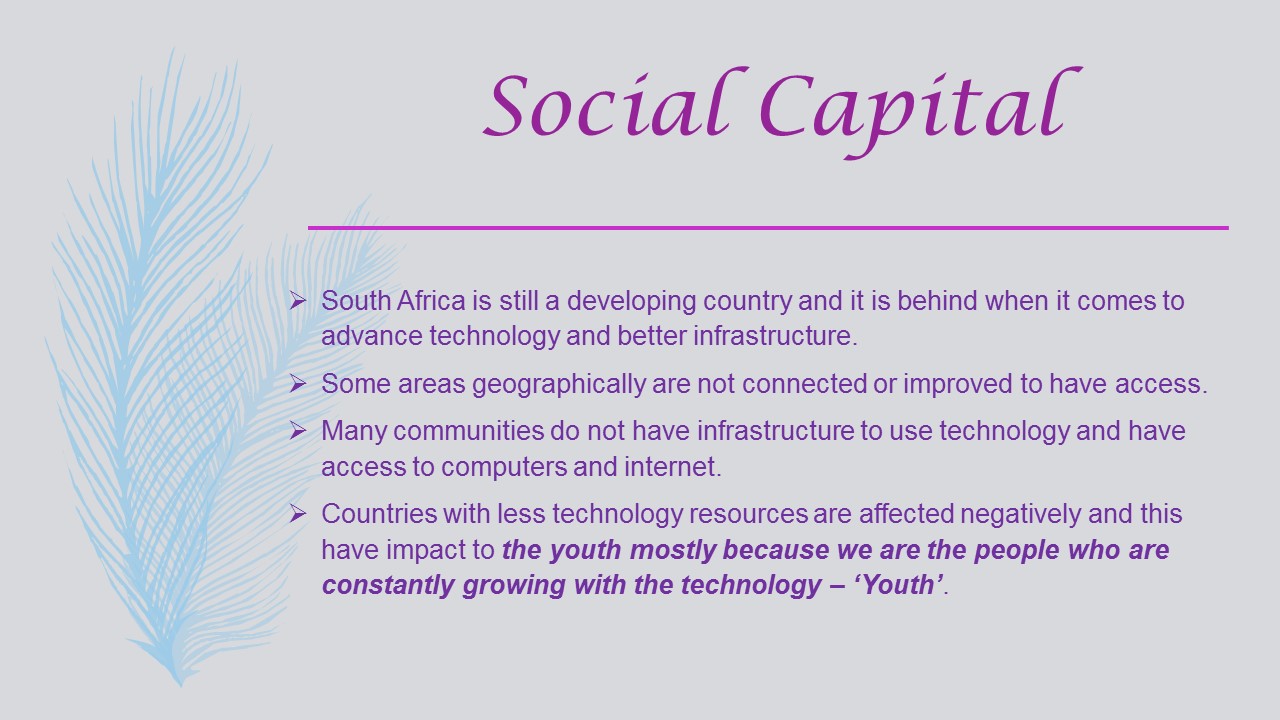
Q.1.3 Electronic poster


Friday, 23 September 2016

Reference


Bibliography


The Independent Institute of Education. 2016. Digital Citizenship Module Manual. Johannesburg: Unpublished.

Masilo, M. 2016. Digital Citizenship-Slides. Lecturer: Unpublished. [15 August 2016]

Digiteen Wiki. [s.a.] Digital Commerce. [Online]. Available at: <
http://digiteen.wikispaces.com/Digital+Commerce > [Accessed on 18 August 2016]


Gardner, H. 2016. The nine types of intelligences. Available at: < http://skyview.vansd.org/lschmidt/Projects/The%20Nine%20Types%20of%20Intelligence.htm > [Accessed on 21 September 2016]

Question 5: Digital Rights and Responsibilities


5.1A petition of these countries were digital rights are extended to the majority of the citizens.

Petition for Digital Freedom

The world is moving forward and you are standing still. Depriving people of their right to digital citizenship is unacceptable. For your nation to move forward everyone has to be on the same level of development and due to the fact that we are against development our journey downhill is due relatively soon. The petition is in place to help us ‘youth’ in making our country a better place while contributing to or riches simultaneously.


The rights and the responsibilities include:

  1. The people have the right to privacy
  2. The right to freedom of expression
  3. The right to credit for personal work
  4. The right to our identity
  5. The responsibility to give credit for other peoples’ work
  6. The responsibility to follow good online etiquette


5.2Creating a Digital Bill of Rights for the Internet.

Digital Bill of Rights for the Internet

1. We are all born free and equal- we all have our own thoughts and ideas.

2. Don’t discriminate- everyone has rights, regardless of our differences.

3. We have the right to live in freedom and safety.


4. Remember the Human- Never forget that the person reading your communication is actually a person with feelings and can get hurt; never say anything online that would not say to your reader’s face.

5. The right to privacy- nobody has the right to invade our personal space on the internet without our permission.

6. Freedom of thought- we have the right to believe what we want to believe in.

7. Freedom of expression- everyone has the right to make up their own minds, think what they want, and say what they think and to share their ideas with others over the internet.

8. Sharing- everyone has the right to freely share their ideas and opinions lawfully on the internet.

9. Property- digital citizens have the right to benefit from what they create, and be secure in their electoral property on the internet.

10. All digital citizens are created to have equal rights and responsibilities on the internet.


11. Make yourself look good online- check grammar and spelling before your post, as most people may judge your intelligence based on the grammar and spelling.


12. Share expert knowledge- offer answers and help others where you can.


The above answers for Question 5 number 5.2 was stated on the (Module Manual, 2016, pp.89-90)

Question 4: Digital Etiquette


4.1Online etiquette has become important part of our social and working lives. There are two (2) relevant articles on this topic below.


Digital etiquette otherwise referred to as netiquette is a basic set of rules to be implemented by Internet users in order to ensure the internet is better for all users. It basically means “the use of good manners in online communication such as email, forums, blogs, and social networking sites” (Digital Citizenship, Auburn University. [s.a.]). The word etiquette means “The forms required by good breeding or prescribed by authority in social or official life.”


First article

Penny Sparrow calls black people ‘monkeys’

AddThis Sharing Buttons

Share to FacebookShare to TwitterShare to WhatsAppShare to Email


Penny Sparrow compared black people to monkeys, and questioned why they are allowed on beaches.

Penny Sparrow, a white estate agent from KwaZulu-Natal, has received criticism on social media for a post she made on Facebook. In the post, she compares black people to monkeys. She was complaining about the “monkeys who have no education” that are allowed to be released on New Year’s Eve and New Year’s Day to go on to public beaches and so “allowing them loose is inviting huge dirt and troubles and discomfort to other”.

This received criticism on Twitter, with Mmusi Maimane saying: “Penny Sparrow comments are racist. They are an insult to me and our party. We have too many of these in SA & we must criminalize these”.
Sparrow went on Facebook to apologies for her comments. She said her comments came as a reply to a statement she read about dirty beaches on New Year’s Day. She also apologized to people who have taken her statement “personally”, explaining she is not racial and in fact “helps underprivileged people of all races”.
Recommended articles to read:
Second article


Examples of inappropriate digital conduct
Rude or hurtful comment - If you don’t agree with someone’s ide, don’t’ type a comment. If you have to, or if they ask you to tell them what you think of it, suggest ways in which they can improve it, or say what you think of it in a polite and gentle way.

Posting without permission - Ask permission before you post things online if they aren’t yours. For example, if you want to put a picture online and your friends are in the picture, ask them if they mind.

Writing in all caps - Don’t write in all caps, because when you write in all capital letters online it is considered yelling.

Cyber-bullying - Bullying people online can really hurt their feelings and lead to low self-esteem.

Effect on society 
One of social behaviours' biggest influencer is the socio-economic environment and etiquette is societal norms. It can therefore be said that netiquette describes the rules that society dictates we implement whilst we are online.

A disregard for etiquette will affect society in such a way that our society will eventually fall into ‘chaos’. A disregard for netiquette will not have the exact same effect however; it will most definitely contribute to the downfall of a society. It is interesting to note that most people’s behaviour in the offline world is completely different from that of the online
world.


Question 3: Digital Communication

3.1How I envision the impact on the future of business and society. A post in the title of ‘The Internet of Things’.

The term Internet of Things generally refers to scenarios where network connectivity and computing capability extends to objects, sensors and everyday items not normally considered computers, allowing these devices to generate, exchange and consume data with minimal human intervention.


The Internet of Things has the potential to really shift the way we do things, think and learn (Module Manual, 2016, p.77). Is a system of interrelated computing devices, mechanical and digital machines, objects, animals or people that are provided with unique identities and the ability to transfer data over a network in one form or the another, receiving and processing information in real time and creating new ways of making decisions back-up by the availability of information.

Internet of Things will affect future businesses in core areas such as production, advertising, sale, market research, and job market and enterprise resource management. Most of the advantages are not user targeted but with the introduction of Internet of Things, massive volume of information about the consumer lifestyle and interests can be collected. This data reveals that the hidden buying patterns of each user which provide the insight to advertisers to advertise to each and every consumer.

When coming to market research, all smart household devices are equipped with sensors, which will do the market research free of charge for the businesses. Internet of Things products will not only generate revenue for businesses but also provide insight to consumers after the sales. Internet of Things will also have an impact on the hiring processes.

This overview document is designed to help the Internet Society community to navigate the dialogue surrounding the Internet of Things in light of the competing predictions about its promises and perils. The Internet of Things engages a broad set of ideas that are complex and intertwined from different perspectives.


3.2Any four (4) of several aspects of intelligence and their explanation of the importance of these levels with regard to the business context to and the impact of technology.
Spatial Intelligence “Picture Smart”
This is the ability to recognize, use and interpret images and patterns and to reproduce objects in three (3) dimensions namely; successful architects, sculptors and designers are likely to have high spatial intelligence.
Basically, spatial intelligence is the ability to think in three dimensions. Core capacities include mental imagery, spatial reasoning, image manipulation, graphic and artistic skills, and an active imagination. Young adults with this kind of intelligence may be fascinated with spend free time drawing or daydreaming.

Interpersonal Intelligence “People Smart”
This is the ability to understand people's intentions, motivations and desires. This intelligence allows individuals to work well with others. Professions like therapy, teaching and sales attract individuals with high interpersonal intelligence.
Interpersonal intelligence is the ability to understand and interact effectively with others. It involves effective verbal and nonverbal communication, the ability to note distinctions among others, sensitivity to the moods and temperaments of others, and the ability to entertain multiple perspectives.
Teachers, social workers, actors, and politicians all exhibit interpersonal intelligence. Young adults with this kind of intelligence are leaders among their peers, are good at communicating, and seem to understand others’ feelings and motives.

Linguistic Intelligence “Word Smart”
Linguistic intelligence is the ability to think in words and to use language to express and appreciate complex meanings.  It allows us to understand the order and meaning of words and to apply meta-linguistic skills to reflect on our use of language.
Linguistic intelligence is the most widely shared human competence and is evident in poets, novelists, journalists, and effective public speakers. Young adults with this kind of intelligence enjoy writing, reading, telling stories or doing crossword puzzles. (Stated by Howard Gardner)

Logical-Mathematical Intelligence “Number/Reasoning Smart”
According to Howard Gardner it was stated that; Logical-mathematical intelligence is the ability to calculate, quantify, consider propositions and hypotheses, and carry out complete mathematical operations. It enables us to perceive relationships and connections and to use abstract, symbolic thought; sequential reasoning skills; and inductive and deductive thinking patterns.
Logical intelligence is usually well developed in mathematicians, scientists, and detectives. Young adults with lots of logical intelligence are interested in patterns, categories, and relationships. They are drawn to arithmetic problems, strategy games and experiments.